This post may contain affiliate links. Please see my disclosure policy for details.
How to Choose and Build the Perfect Climbing Rose Trellis for Your Garden
Contents
Climbing rose trellises transformed my disaster of a backyard fence into something that makes neighbors actually stop and stare.
I’ll be honest with you. My first attempt at growing climbing roses was an absolute nightmare. I planted three gorgeous ‘New Dawn’ roses along my weathered wooden fence, thinking they’d just naturally climb up like ivy. Spoiler alert: they didn’t.
Within six months, I had a tangled, thorny monster sprawling across my lawn like some botanical nightmare. My husband nearly divorced me when he got snagged trying to mow around them.
That’s when I learned the hard truth about climbing roses.
Climbing Roses Are Liars (Sort Of)
Here’s what nobody tells you when you buy those beautiful climbing roses at the nursery.
They don’t actually climb.
Not like morning glories or clematis that wrap around things automatically. Climbing roses are basically regular roses with absurdly long, whip-like canes that flop everywhere unless you force them to behave.
Without a proper trellis and training, your climbing rose will become a ground-covering beast that attacks anyone who comes near it.
I learned this the expensive, bloody way.
Why Your Trellis Choice Matters More Than You Think
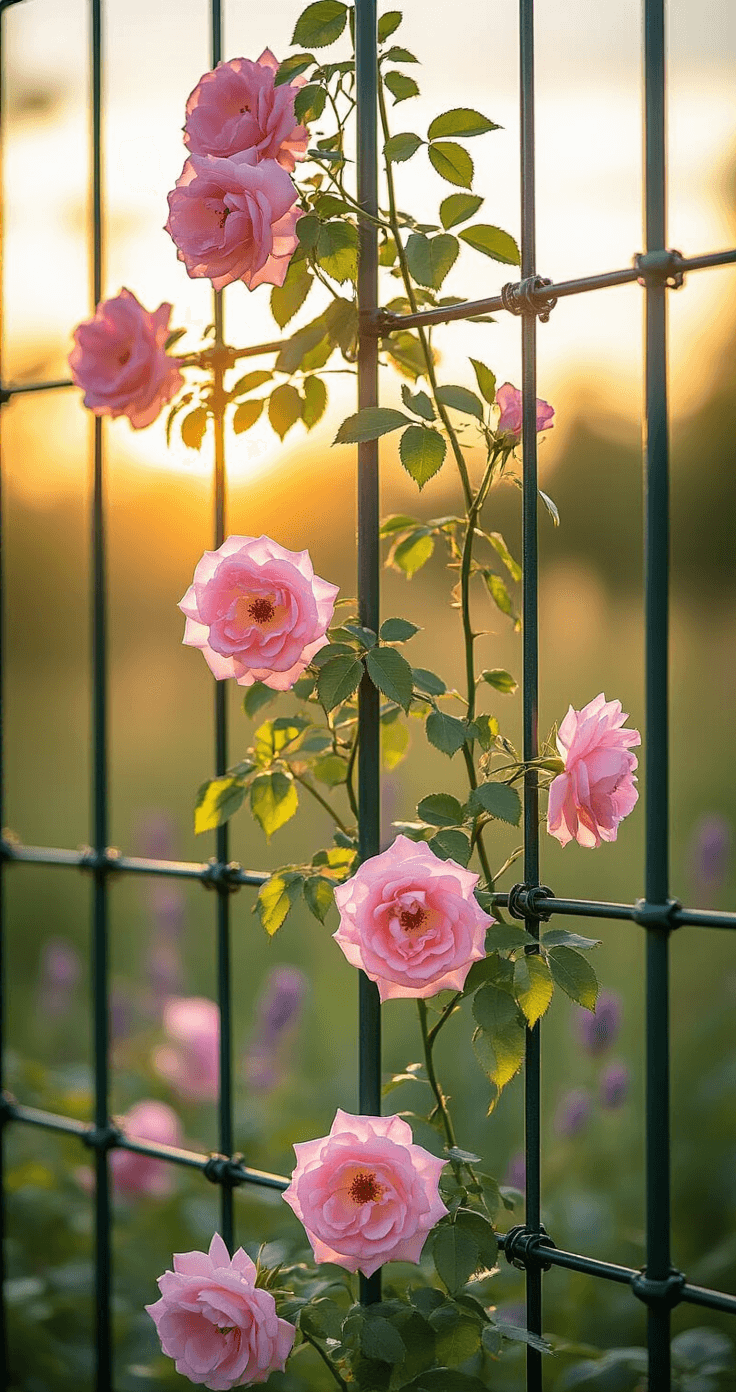
After my initial failure, I bought a cheap wooden lattice panel from a big-box store. It looked pretty for exactly one season.
By year two, the wood started rotting where the rose canes held moisture against it. By year three, the whole thing collapsed during a storm, taking half my rose with it.
Here’s the thing about climbing roses: they’re in it for the long haul.
These plants take 3-5 years just to hit their stride, then they keep going for decades. One of my neighbor’s climbing roses has been on the same trellis for 22 years.
Trying to remove an established climbing rose from its trellis to replace the support structure is like trying to untangle Christmas lights while wearing oven mitts. While angry bees circle your head. And the lights have thorns.
Materials That Actually Last
I’ve now tried pretty much everything, and here’s what I’ve learned:
Metal or wrought iron wins every time.
- Lasts 20+ years minimum
- Supports even the most vigorous varieties
- Worth the upfront cost
Wood can work, but:
- Expect to replace it every 5-7 years
- Cedar or pressure-treated lasts longest
- Budget for multiple replacements over your rose’s lifetime
PVC or vinyl:
- Looks cheap (because it is)
- Can’t support heavy, mature roses
- Degrades in UV light
- Just don’t
The Support Systems That Actually Work
I’ve tested five different trellis systems in my garden over eight years. Some worked brilliantly. Others were expensive mistakes.
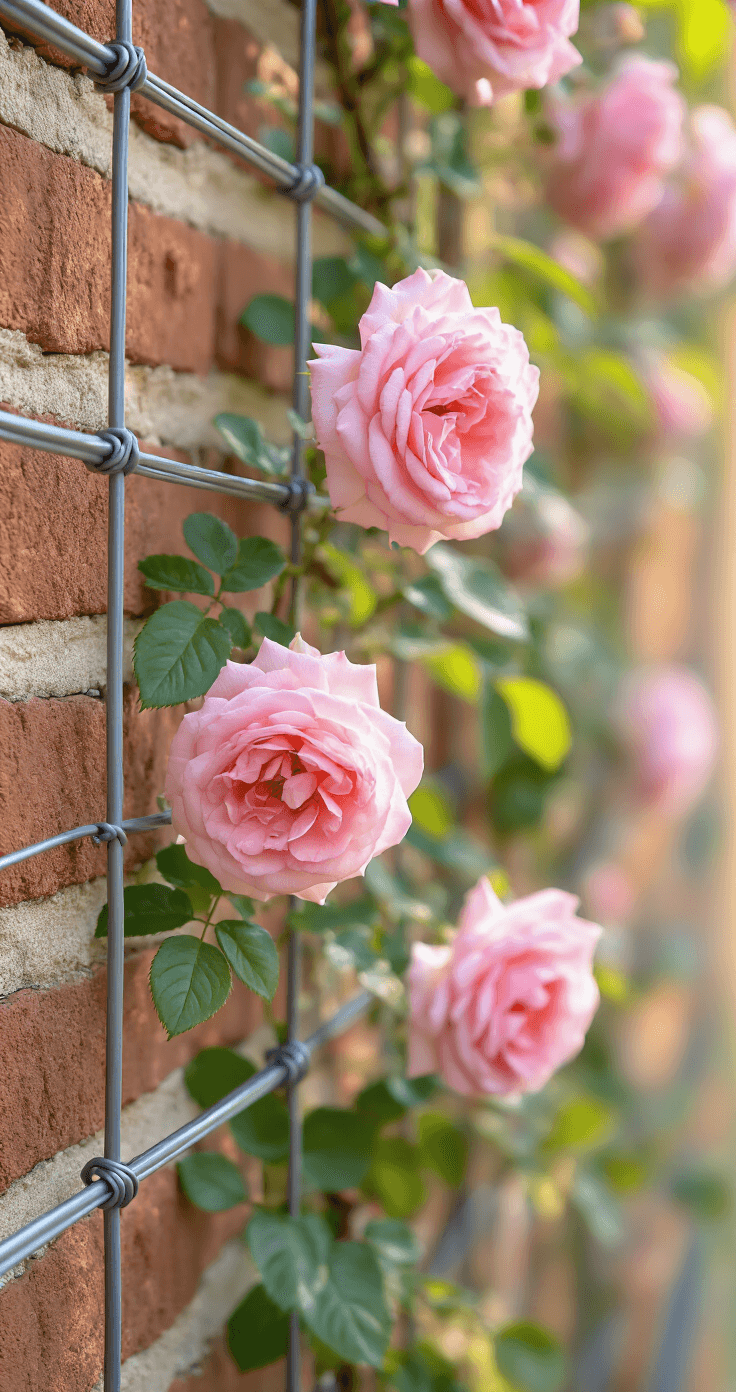
Straining Wire System (My Personal Favorite)
This is the system I use now, and I wish I’d started here.
Here’s how to set it up:
- Place your lowest wire 2 feet from the ground
- Add additional wires every 12-18 inches going up
- Install vine eyes (those little eye-hook things) every 5 feet along the length
- Use galvanized or vinyl-coated wire that won’t rust
The vine eyes are crucial. Skip them, and your wires will sag like a hammock under the weight of mature canes.
I made this mistake once. My beautiful wire system turned into a curved disaster by mid-summer when my ‘Zephirine Drouhin’ hit full bloom.
Trellis Panels
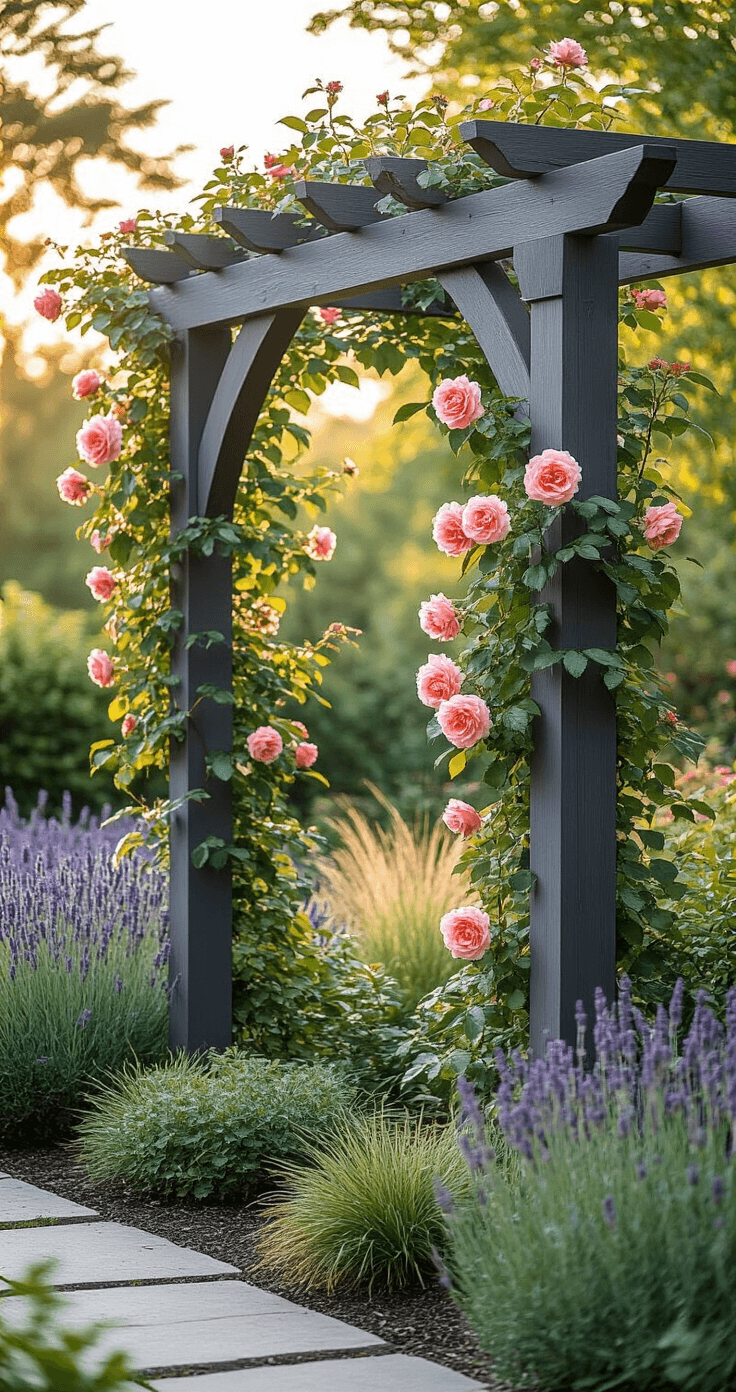
These flat, grid-like panels attach directly to walls or fences.
Pros:
- Easy to find at any garden center
- Simple to install
- Roses tie directly to the structure
Cons:
- Can trap moisture against walls (hello, paint damage)
- Less airflow means more disease potential
- Removing them for house maintenance is hellish
DIY Wooden Framework
I built one of these for my ‘Claire Austin’ rose using cedar 2x2s.
The construction was simple:
- Created a frame 6 feet wide by 8 feet tall
- Added horizontal crosspieces every 18 inches
- Painted everything with exterior paint before installation
- Secured it to fence posts with deck screws
It’s worked well for four years now, but I’m already seeing some weathering.
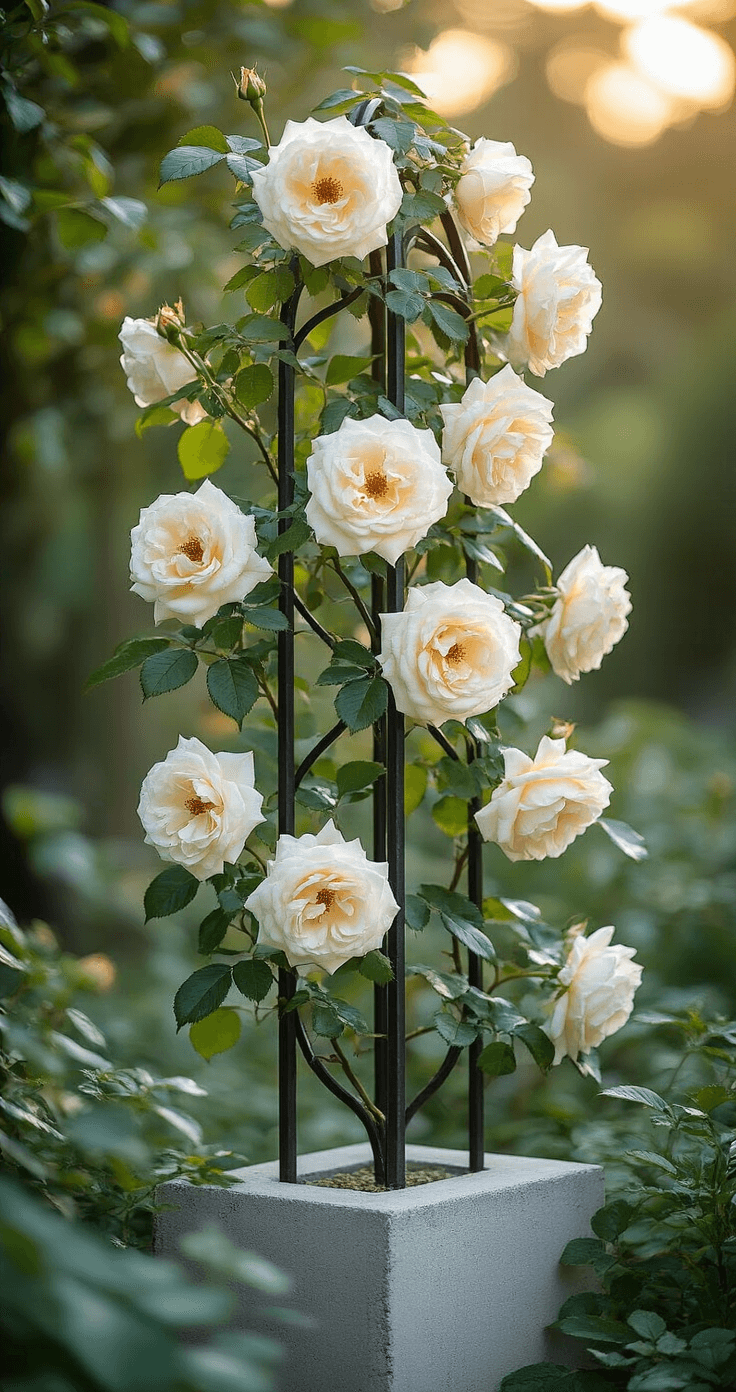
Matching Trellis Size to Rose Reality
This is where I royally screwed up the first time.
I bought a cute 4-foot decorative trellis for ‘American Pillar,’ which grows 20-foot canes. By the end of season two, my rose had completely overwhelmed the trellis and was wandering into the neighbor’s yard.
Different roses need different support:
Compact climbers (8-10 feet):
- ‘Compassion’
- ‘Tropical Lightning’
- ‘The Generous Gardener’
These work perfectly on standard 8-foot trellises or wire systems.
Vigorous monsters (15-20+ feet):
- ‘American Pillar’
- ‘New Dawn’
- ‘Cecile Brunner’
These need serious real estate. Plan for tall, wide support structures or they’ll take over your entire fence line.
I now have ‘New Dawn’ on a 12-foot section of straining wires, and it uses every inch.
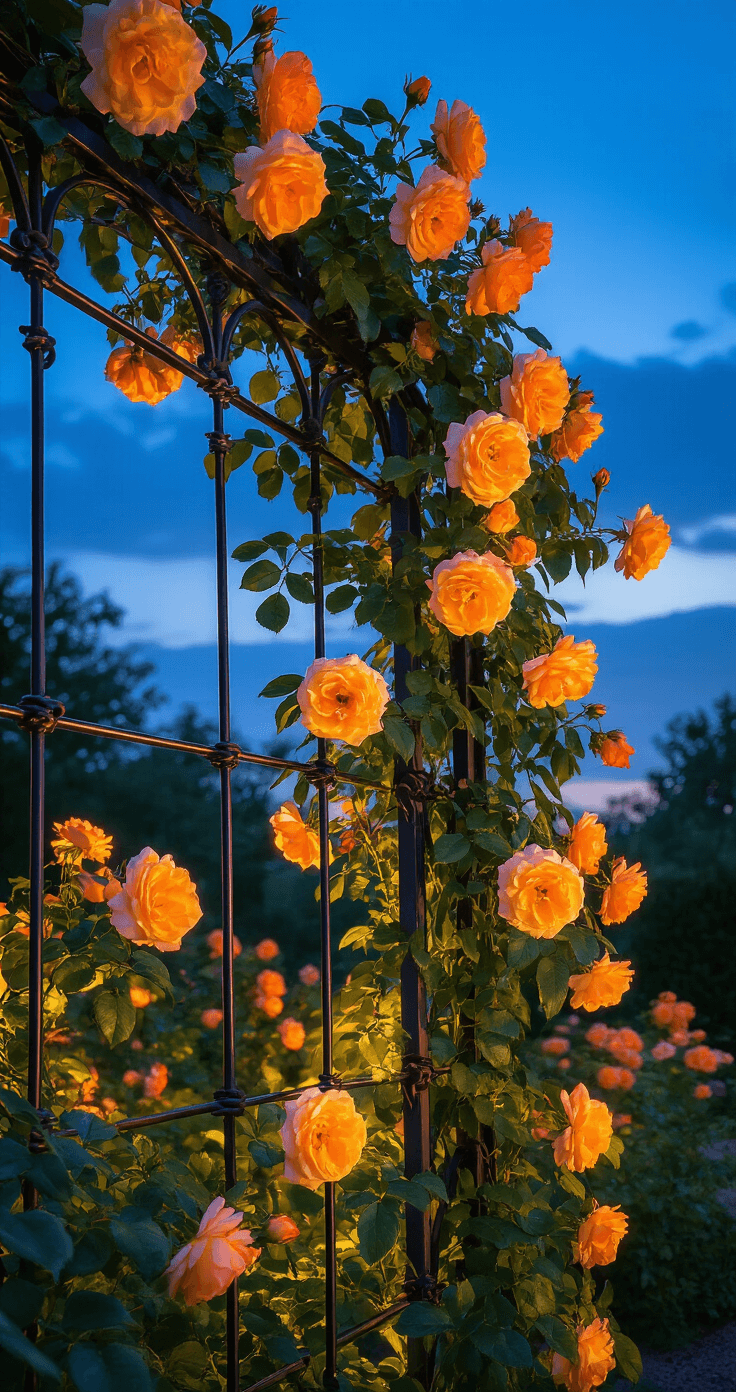
Installation That Won’t Fail
I’ve installed seven different trellises in my garden and helped three neighbors with theirs.
Here’s what I’ve learned the hard way:
For Wall-Mounted Systems
Step 1: Mark your